
Criminal Court Records in Washita County
A criminal court record is the case file a court opens once the state brings charges. It is not the same thing as an arrest or a jail booking. The arrest happens at the Sheriff's Office. The criminal case begins when the District Attorney files a charge in court, and from that point the Court Clerk keeps the file. That file gathers every paper and every event in one place: the charging document, the bond, each plea, each motion, the hearings, and the final judgment.
In Oklahoma, the District Court is the trial court of general jurisdiction, so it hears criminal cases of every level. Felony cases carry a CF prefix on the case number. Misdemeanor cases carry a CM prefix. Both types are filed with the Washita County Court Clerk in Cordell and prosecuted by the District Attorney for District 2. City ordinance offenses and city traffic tickets are a separate track that may sit in a town municipal court, not the District Court, so a reader chasing a city citation should check the issuing city first.
The case file follows the charge, not the person. One defendant can have several case numbers. Each number opens its own record with its own charges, pleas, and outcome.
How to Search Washita County Criminal Court Records
Two free state systems carry Washita County District Court cases. The Oklahoma State Courts Network, known as OSCN, lists Washita County in its court dropdown and is best when a case number is in hand. On Demand Court Records, known as ODCR, also lists Washita as a participating court and is strong for name searches. Both let a reader open a docket and read the case history at no charge.
- Open the OSCN docket search, pick Washita County District Court from the court list, and enter the exact case number if you have one. The example format shown is CF-2014-1.
- If OSCN does not return the case, use its non-OSCN link or go straight to ODCR, choose Oklahoma District Courts or All Courts, then select Washita and search by party name in Last, First order.
- Narrow the search by case type. Use CF for a felony, CM for a misdemeanor, and add a filing-date or activity-date range when the name is common.
- Open the matching case to read the full docket, the charges, the plea, and the disposition. Each docket line is a dated event in the file.
- Request a certified copy from the Court Clerk when you need a document that holds up in a legal setting. Online pages are lookup tools, not certified court copies.
The online systems show case and docket information, but a certified record must come from the court custodian. The Court Clerk also handles older files, sealed or restricted matters, and any document that is not posted online. For a wider look across every case category, the Washita County court records page covers civil, family, probate, and traffic files alongside criminal cases.
Stages of a Washita County Criminal Case
A criminal case moves through fixed steps, and each step leaves its own marks in the record. The docket is a running timeline, so reading it in order shows how the case grew from a filed charge to a final outcome. The charges themselves get a closer look on the Washita County arrest records and court charges page.
Case flow: Charges Filed › Arraignment › Pretrial / Motions › Plea or Trial › Disposition › Sentencing
| Stage | What Happens |
|---|---|
| Charges Filed | The District Attorney files an information that lists each count and the statute alleged. This opens the case number and starts the file. |
| Arraignment | The court reads the charges, sets or reviews bond, and the defendant enters a first plea such as not guilty. |
| Pretrial / Motions | Lawyers file motions, exchange evidence, and ask the judge to rule on issues. Hearings and continuances show up here. |
| Plea or Trial | The case ends in a plea, or it goes to trial where a judge or jury decides guilt. Most cases close with a plea. |
| Disposition | The court records the result of each count: guilty, not guilty, dismissed, or deferred. |
| Sentencing | On a conviction, the judge sets the punishment, which may include jail, probation, fines, costs, or restitution. |
Who Files Charges in Washita County Criminal Cases
The District Attorney decides whether to file charges, what counts to bring, and how to pursue a case. Washita County sits in Oklahoma District Attorney District 2, which also covers Beckham, Custer, Ellis, and Roger Mills counties. Angela Marsee serves as the District Attorney for the district. The Washita office sits at the courthouse in Cordell, and the same office handles victim restitution and several court-payment categories.
The District Attorneys Council keeps an official page for District 2 with the Washita courthouse address, phone, fax, and payment links. You can view it at the District Attorney District 2 page.
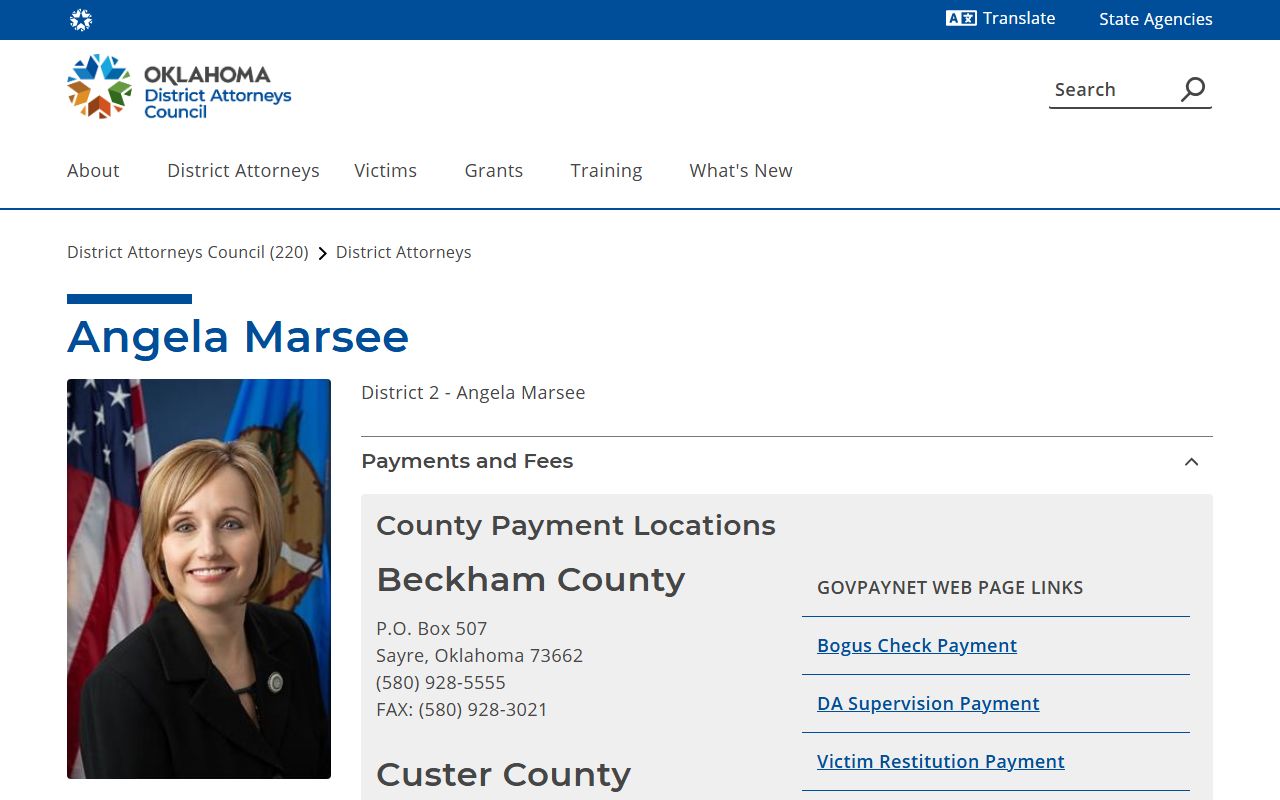
That page is the official source for the office that files Washita County criminal charges and collects restitution. It confirms the Cordell courthouse address and the prosecutor's contact lines.
To confirm which counties share the District 2 office, the District Attorneys Council also publishes a statewide district list. The District Attorneys Council district list names every district and its member counties.
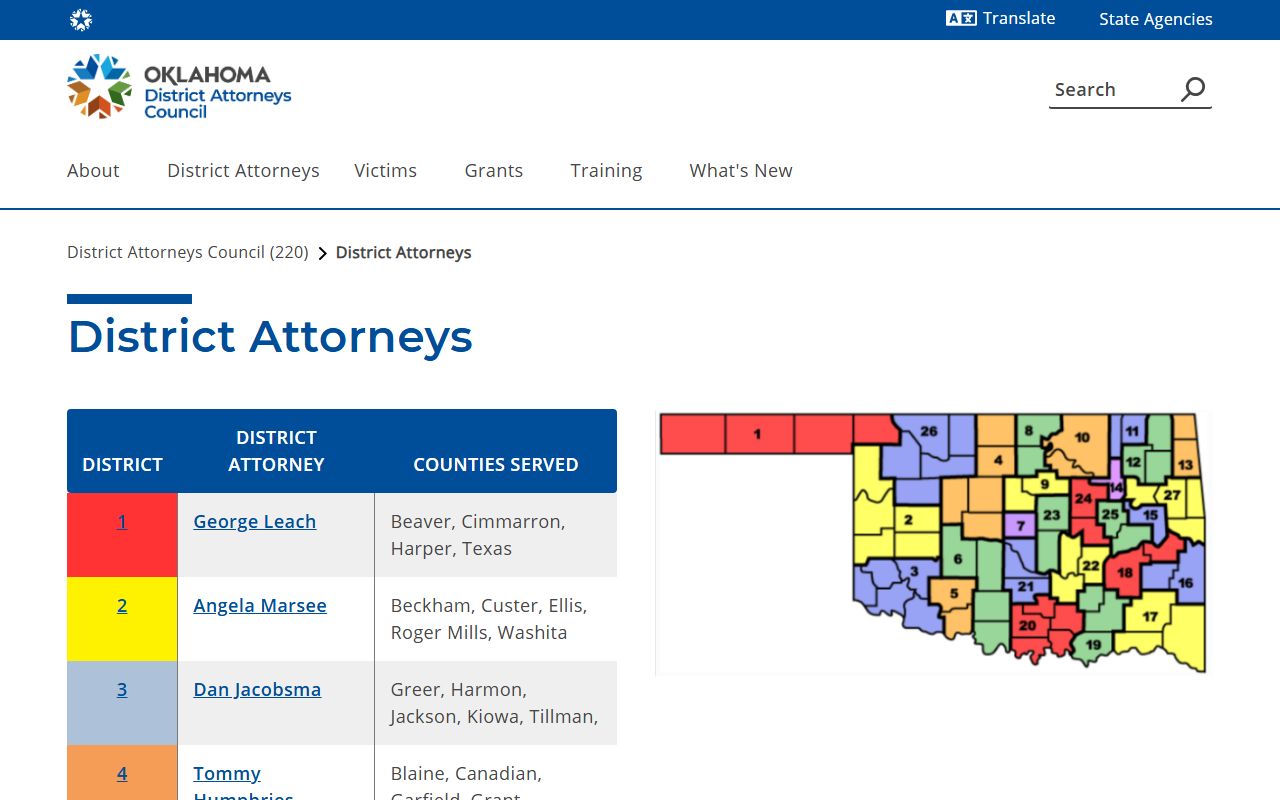
The list shows Washita grouped with Beckham, Custer, Ellis, and Roger Mills under District 2. On the other side of the case, the Oklahoma Indigent Defense System provides court-appointed lawyers for defendants who qualify, with Michael Housley serving as the Deputy Division Chief for the Washita coverage area.
What a Washita County Criminal Court Record Shows
A criminal case file is built from many small fields. The header names the case and the parties. The docket logs each event by date. The financial lines track bond, fines, costs, and restitution. Reading the file field by field shows both what the state alleged and how the court resolved it.
| Field | What It Shows |
|---|---|
| Case Number | The court ID with a type prefix. CF marks a felony and CM marks a misdemeanor, followed by year and sequence. |
| Court / County | Washita County District Court, the court that holds and hears the case. |
| Defendant | The person charged. The State of Oklahoma is listed as the opposing party. |
| Charges | Each count, the statute alleged, and any later amendment, reduction, or dropped count. |
| Plea | The defendant's formal answer, such as guilty, not guilty, or no contest. |
| Docket Events | Filings, motions, orders, hearings, warrants, and continuances, each stamped with a date. |
| Disposition | The result of each count, including dismissed, deferred, acquitted, or convicted. |
| Sentence | The punishment on a conviction: jail or prison time, probation, fines, costs, or restitution. |
Some details stay out of public view. Court systems redact Social Security numbers, financial account numbers, minor names, protected addresses, and any sealed content. A blank or hidden field does not mean the record is wrong; it means the law keeps that piece private.
Reading Dispositions and Sentences
The disposition is the heart of the file. It tells you how each count ended. A case can hold several counts with different results, so one charge may be dismissed while another ends in a guilty plea. The sentence sits next to a conviction and spells out the punishment the judge ordered.
Plain words help here. A short glossary covers the terms that show up most in an Oklahoma criminal docket.
- Arraignment
- The hearing where the court reads the charges and the defendant enters a first plea.
- No contest
- A plea, also called nolo contendere, that accepts the punishment without admitting guilt.
- Deferred sentence
- A delay of judgment that can end in dismissal if the defendant meets set conditions.
- Disposition
- The final or current result of a count or the whole case.
- Judgment and Sentence
- The court order that records a conviction and sets the punishment.
- Restitution
- Money the court orders a defendant to pay a victim for loss.
Watch the dates as you read. A guilty plea entered on one date and a sentence set on a later date are two events in the same file. The most recent disposition line is the one that tells you where the case stands now.
Charges vs. Convictions in Washita County
Being charged is not the same as being convicted. A criminal court record can show charges that were dropped, dismissed, or that ended in acquittal. A charge is an accusation the state must still prove. A conviction is the court's final finding of guilt. Reading the disposition keeps the two apart.
| Charge | Conviction | |
|---|---|---|
| Stage | Accusation filed by the state | Verdict or accepted plea |
| Burden of Proof | Probable cause | Beyond a reasonable doubt |
| Can It Change | Yes, it can be amended, reduced, or dropped | Final unless appealed or vacated |
| Public Record | Yes | Yes |
This gap matters most in a background context. A file may list a serious filed charge that the court later dismissed. The charge stays in the docket history, but it carries no conviction. Always trace each count to its disposition before drawing a conclusion.
Statewide Criminal Records and Sentenced Offenders
County court records cover the case as it sat in Washita County. For people sent to state prison, Oklahoma keeps a separate statewide lookup. The Oklahoma Department of Corrections runs an offender search that covers sentenced state inmates and fugitives across all 77 counties. It is a custody and sentence tool, not a court docket.
You can run a statewide check through the official Oklahoma DOC offender lookup, which lists sentenced offenders and notes that its data is abbreviated.
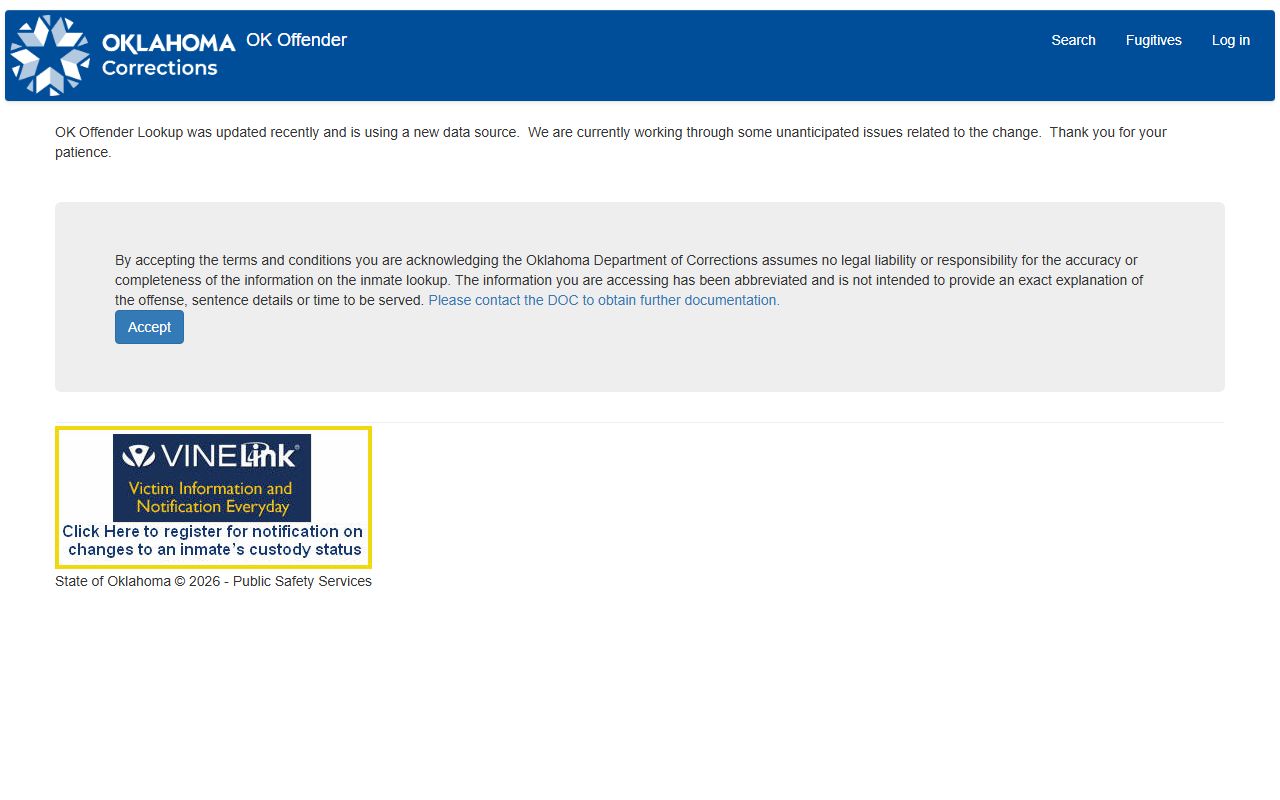
The DOC page itself warns that its information is shortened and is not a complete account of the offense, sentence, or time to serve. Treat it as a starting point, then go back to the Washita County District Court file for the full charge, plea, and sentence detail. County jail custody is a different matter handled by the Sheriff, not the state prison system.
Sealed vs. Expunged Records
Some criminal records leave public view. Oklahoma law lets certain people seal or expunge eligible records under 22 O.S. 18. The two terms are close but not the same, and the path runs through the court and then the state bureau.
| Sealed | Expunged | |
|---|---|---|
| Visibility | Hidden from public search | Treated as if it never existed for most purposes |
| Law Enforcement | Limited access remains | Very limited access |
| Eligibility | Set by category under 22 O.S. 18 | Set by category under 22 O.S. 18; the State may object |
| Timing | Court order controls | About one month after OSBI receives the certified order |
The Oklahoma State Bureau of Investigation makes the process clear. It will not pre-approve eligibility, and the State can object even when a person seems to qualify. After a judge grants relief, the person must get a certified copy of the order and make sure OSBI receives it. Court and arrest record changes usually take about a month from there. Expungement does not destroy fingerprints; it limits the public link to the sealed arrest.
Public Access to Washita County Criminal Court Records
Adult criminal case files are public records in Oklahoma. The Open Records Act sets the policy that the public can see government records so people stay informed. Court dockets, charges, pleas, and dispositions fall under that open framework, which is why OSCN and ODCR can post them. Public access is not the same as unrestricted access, though, since sealed, juvenile, and protected content stays out.
Key Statutes:
Oklahoma Statutes § 51 O.S. 24A.5 - Public records are open for inspection and copying unless a law makes them confidential.
Oklahoma Statutes § 51 O.S. 24A.8 - Governs the law-enforcement records that stay open for public inspection.
Background Check Considerations
A casual case lookup and a formal background check are different jobs. Reading a Washita County docket online tells you about one case. A background check for hiring, housing, or credit must follow the federal Fair Credit Reporting Act and use a regulated agency. Free court searches are fine for personal knowledge, but they are not a screening report and should not be used as one.
Important: This site is not a consumer reporting agency under the FCRA, and its information cannot be used for employment, tenant, credit, or other regulated screening.
Restricted Criminal Court Records in Washita County
Not every criminal matter is open. Juvenile and youthful offender cases carry tighter rules, so a public docket may omit detail or show nothing at all. Mental health cases can appear at a category level while the medical and commitment content stays private. Sealed and expunged records drop out of public search once a court orders it.
Active investigations and some pretrial materials may also be held back until the file moves forward. When an online search comes up short, the gap may be a restriction rather than a missing case. The Court Clerk can confirm whether a record exists, whether it is restricted, and how to request a certified copy of anything that is public. Active-warrant status tied to a case is confirmed through the Sheriff or the court, not an online docket alone.