
Washita County Arrest Records and Court Charges
A Washita County arrest record is the account of an arrest itself. It notes who was taken into custody, the agency that made the arrest, the date, and the booking that follows at the jail. In Washita County that booking happens at the Sheriff's Office. An arrest alone does not set the charges in stone. The District Attorney reviews the case and decides what to file. When the prosecutor files those charges with the Court Clerk, they enter the District Court case file and become the court charge record.
These are two different records kept by two different offices. The arrest and booking side belongs to the Sheriff and the jail, which is where the roster and custody detail live. The court charge record shows what the prosecutor actually filed and how each charge moves through the case. The full case file, with pleas, hearings, and the final outcome, is part of the county criminal court records. Court charges after arrest are the bridge between the two.
Arrest and Booking Records in Washita County
Arrest and booking records start at the Washita County Sheriff's Office. When deputies book a person, they log the arrest, the alleged offense, and the booking date. The jail roster shows who is in custody right now. For a closer look at custody status, booking detail, and the in-custody roster, the Washita County inmate records page covers the jail side in full.
The Sheriff's Records Division handles requests for these law enforcement files, and its records request page explains how open records requests are routed.
That division maintains Sheriff's Office records such as incident, arrest, and booking reports. Those files are separate from the court case file the Clerk keeps once charges are filed.
Note: Arrest and booking records come from the Sheriff, while filed charges, pleas, and sentencing are District Court records kept by the Court Clerk.
Find Washita County Arrest Records
Filed charges show up in the District Court case file, not on a booking blotter. Two free public portals carry that record. The Oklahoma State Courts Network, or OSCN, and On Demand Court Records, or ODCR, both list Washita County District Court. Charges, counts, statute citations, pleas, and disposition appear in the docket once a case is filed.
- Open the OSCN docket search and pick Washita County District Court, or go to ODCR and choose Washita.
- Search by defendant name in Last, First format, or enter the case number if you have it.
- Open the case and read the charge list, including each count and the statute behind it.
- Check each charge's code, severity level, and current status in the docket entries.
Case prefixes help narrow a search. CF marks a criminal felony, and CM marks a criminal misdemeanor. For certified copies or older files that are not online, the Court Clerk is the custodian of the court record.
Filing Charges After a Washita County Arrest
A Washita County arrest does not create a court charge on its own. The charge record begins when the prosecutor files a charging document with the Court Clerk. Oklahoma uses three main types. Most felony and misdemeanor cases here start with an Information filed by the District Attorney. A grand jury indictment is the less common path. Complaint terminology is also used at the early stage of a case.
| Complaint | Information | Indictment | |
|---|---|---|---|
| Filed By | Officer / Prosecutor | Prosecutor | Grand Jury |
| Common For | Misdemeanors | Many felonies | Serious felonies |
| Starts | The case | The case | The case |
Who Files Charges in Washita County
The District Attorney decides the charges, not the arresting officer. Washita County sits in Oklahoma District Attorney District 2, which also covers Beckham, Custer, Ellis, and Roger Mills counties. Angela Marsee serves as the District Attorney for that district. After reviewing the arrest and the evidence, the prosecutor can file the charges as alleged, file different charges, add counts, or decline to file at all.
Charging is a judgment call. The prosecutor weighs the proof, the statute, and the facts. You can reach the District Attorney's District 2 office for questions about a filed prosecution, though that office is the charging party and not a neutral record desk. For the filed record itself, the Court Clerk and the online dockets are the better stops.
Charge Status in Washita County Records
Charges are not fixed once filed. As a case moves, a charge can be amended, reduced, added, dropped, or dismissed. The docket records each change. Reading the current status tells you where a charge stands now, which is often more useful than the charge first booked at the arrest.
| Status | What It Means |
|---|---|
| Pending | The charge is filed and active. The case is still moving and has no final outcome yet. |
| Amended / Reduced | The prosecutor changed the charge, such as lowering a felony to a misdemeanor. |
| Dismissed | The court dropped the charge. A dismissal can be with prejudice or without prejudice. |
| Nolle Prosequi | Latin for unwilling to pursue. The prosecutor declines to go forward on that charge. |
Note: A dropped or dismissed charge can still appear in the public record unless it is later sealed or expunged under state law.
Bonds After Washita County Charges
After charges are filed, a bond often sets the terms of release. A bond is money or a promise that secures release and a return to court. A bondsman, also called a surety, can post it. In Washita County the paperwork matters as much as the cash.
The Sheriff's Office bondsmen page spells out the rules for posting a bond.
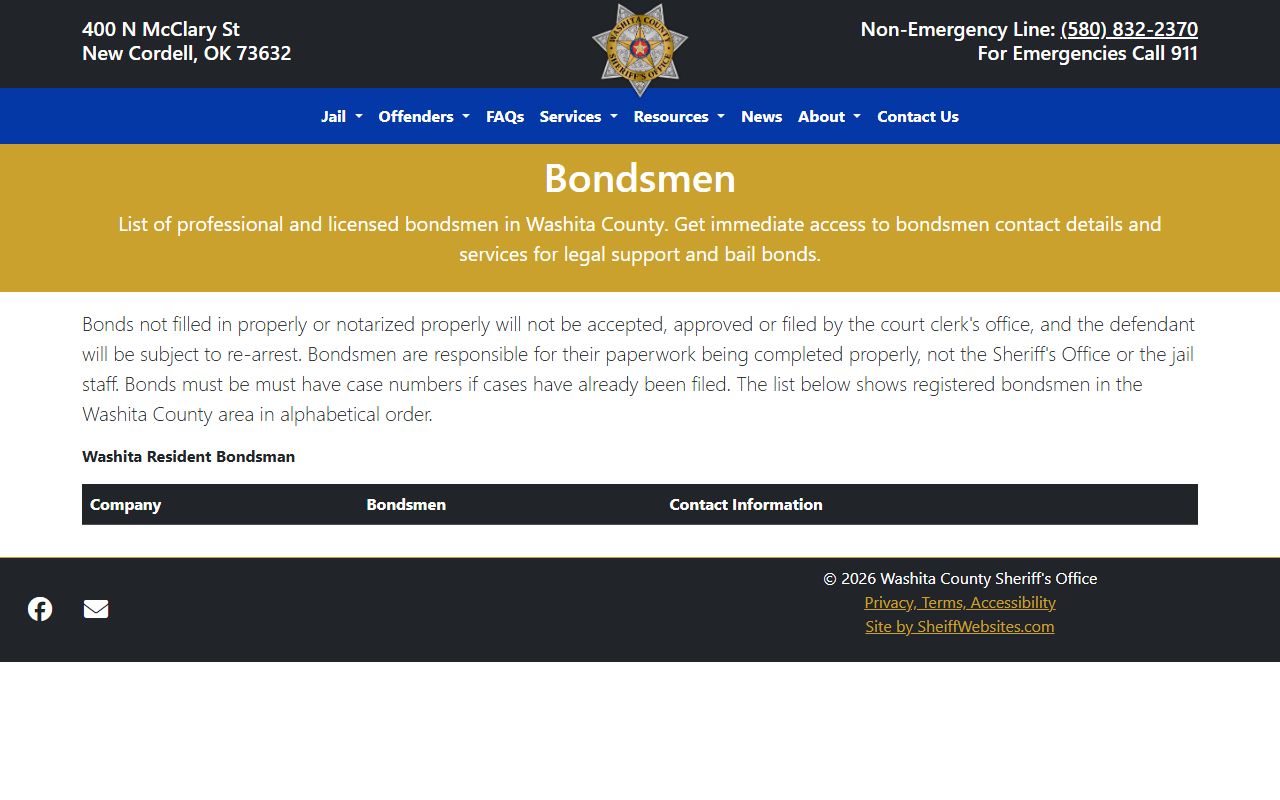
Bonds that are not filled out or notarized properly will not be accepted, approved, or filed by the Court Clerk, and the defendant can be subject to re-arrest. Once a case is filed, the bond paperwork needs the case number to match the charge record.
Charges vs. Convictions
Being charged is not the same as being convicted. A charge is an accusation. A conviction is the result of a guilty plea, a no contest plea, or a guilty verdict. The two carry very different weight, and confusing them can do real harm to a person.
| Charge | Conviction | |
|---|---|---|
| Stage | Accusation | Verdict or plea |
| Burden of Proof | Probable cause | Beyond reasonable doubt |
| Public Record | Yes | Yes |
Washita County Charge Codes and Levels
Each charge ties to a specific statute. The court record lists the law section alleged to have been broken, the count number, and the severity level. Oklahoma sorts most crimes into felonies and misdemeanors. A felony is the more serious class and can bring prison time. A misdemeanor carries lighter penalties, often county jail or a fine. Municipal tickets and ordinance violations sit lower still.
One arrest can produce several separate charges. A single booking might list multiple counts, each with its own code and its own status.
- The statute section alleged to have been violated
- The count number within the case
- The charge level, such as felony or misdemeanor
- The current status of that count
Drug Court and Charge Diversion
Not every charge ends in a standard sentence. Oklahoma runs problem-solving courts that route eligible defendants into treatment instead of jail. Adult drug court is the best known. It gives eligible nonviolent felony defendants a chance to finish a structured, court-supervised treatment program.
The state's adult drug court page describes how the program works.
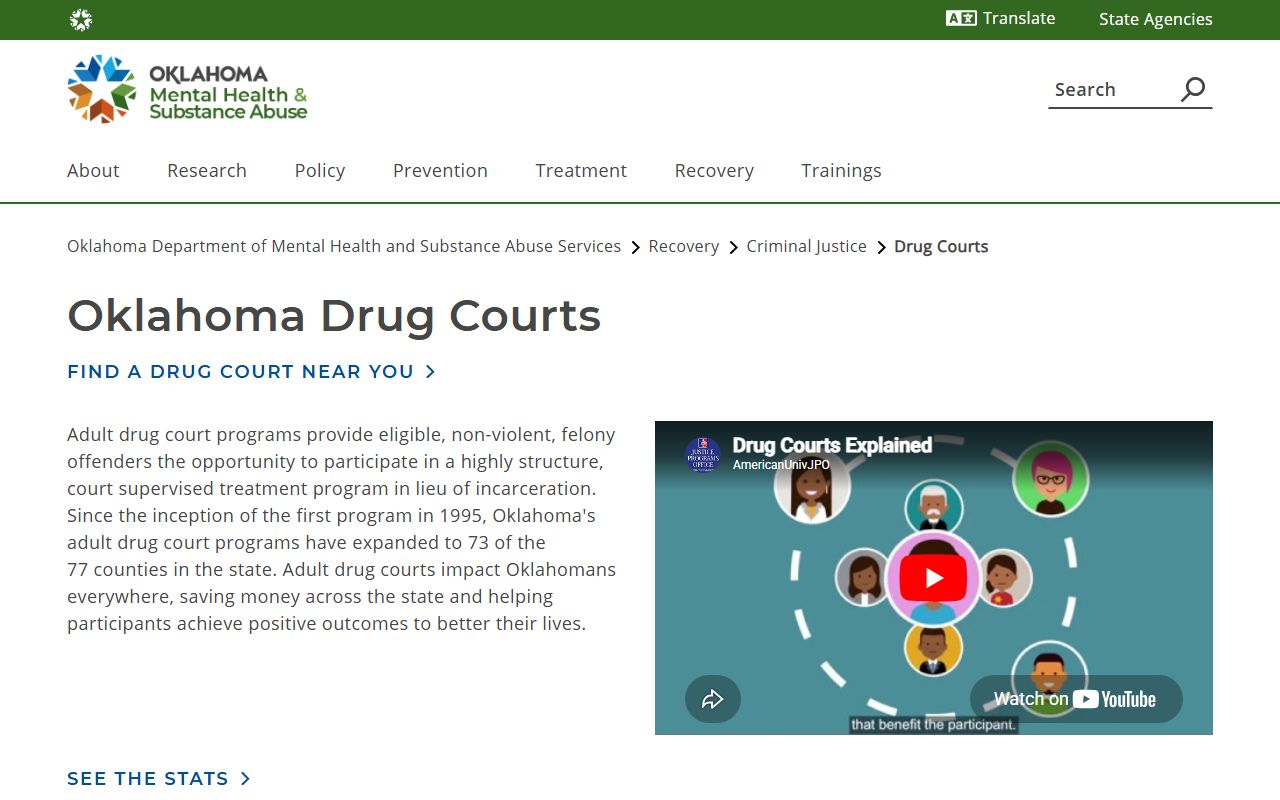
The program began in 1995 and now reaches most Oklahoma counties. When a defendant enters drug court, the docket may show the charge moving into that track, though treatment details are often less public than ordinary case entries.
Statewide Charge and History Lookups
Court dockets show charges county by county. A full criminal history pulls them together at the state level. The Oklahoma State Bureau of Investigation, or OSBI, keeps the statewide criminal history record built from fingerprint-based arrests and dispositions. That record is the standard source for a formal background check in Oklahoma.
The Oklahoma Department of Corrections also runs a free OK Offender Lookup for sentenced offenders and fugitives. Its own disclaimer warns that the data is abbreviated and is not a complete account of any offense or sentence. County jail custody and state prison custody are different systems, so the DOC tool will not always match the Sheriff's current roster.
Sealed vs. Expunged Records
Some charge records can be hidden or erased from public view. Oklahoma handles this through sealing and expungement under 22 O.S. 18, a process run with the OSBI. Eligibility depends on the category of the arrest, charge, dismissal, acquittal, or conviction.
| Sealed | Expunged | |
|---|---|---|
| Visibility | Hidden from public | Treated as though it never existed |
| Law Enforcement | Limited access | Very limited |
| Eligibility | Set by 22 O.S. 18 categories | Court order required; State may object |
The OSBI expungement process makes clear the agency cannot pre-approve eligibility, and the State may object even when a person qualifies. After the OSBI receives a certified order, court and arrest record expungement generally takes about a month. Fingerprints are not destroyed, but the public link to the sealed arrest is removed.
Background Checks on Washita Charges
A casual name search and a formal background check are not the same thing. Pulling a docket on OSCN or ODCR is a quick public lookup. A regulated background check for hiring, housing, or credit follows the Fair Credit Reporting Act and must use an approved consumer reporting agency. For the official Oklahoma record, the OSBI is the source of record.
Important: This site is not a consumer reporting agency under the Fair Credit Reporting Act, and its information cannot be used for hiring, housing, credit, or other FCRA-regulated decisions.
Restricted Charge Records in Washita County
Not every charge record is open to the public. Oklahoma law opens most court and law enforcement records under the Open Records Act, yet several categories stay closed or redacted. Knowing which records are withheld saves time before a search.
- Juvenile and youthful offender charges
- Sealed or expunged charges
- Adoption and mental health case content
- Protected victim addresses and minor names
Law enforcement records carry their own access rules under 51 O.S. 24A.8, the section that governs which arrest and incident records the public can inspect. When a charge is sealed, dismissed and later expunged, or tied to a juvenile, it may not appear in a standard search at all. For anything that should be public but is missing online, the Court Clerk holds the certified file.